What "AI-ready" data actually means
An AI-ready data product is a dataset that an agent can use to reliably and accurately answer questions.
Agents are quickly becoming the most important user for analytical data.
Every data product team we speak with is seeing agent usage grow in real time. End-users are querying data via MCPs or asking questions in "conversational analytics" apps, if they are available. If they're not, they're connecting an agent directly to the data via a CLI or API in the platform of their choice.
The upside of agentic analytics is enormous for data product teams. In a world where anyone with a question can get an answer from a data product in minutes, the cost of using data decreases exponentially. Data shifts from a hard-to-use asset to a mass market product. That means more usage, more users and more value for data.
However, the speed and democratization offered by agentic analytics also brings risk. When an analyst hits a column that looks off or can't figure out how to join a table, they ask you. An agent doesn't. It picks an interpretation, runs the query, and hands back a number that sounds just as confident either way.
The fundamental problem is that most analytical data products were designed for humans to operate, not machines. They were designed for analysts who had years of institutional knowledge, wrote one query at a time, and processed metadata at human speed.
How you make those agents successful in generating insights is now the most important question every data product team should be asking. Below, we walk through how to design data products for agents -- what we call "AI-ready data products."
What is an AI-ready data product?
An AI-ready data product is a dataset that an agent can use to reliably and accurately answer questions. That's it. If you can point an agent at the dataset, ask it a relevant question, and get an accurate answer back, your data product is "AI-ready."
It's helpful to think of an agent as simply a different user. Just as we might design a data product differently for a salesperson vs. an algorithmic trader, we'll design a data product differently for an AI agent than for a human.
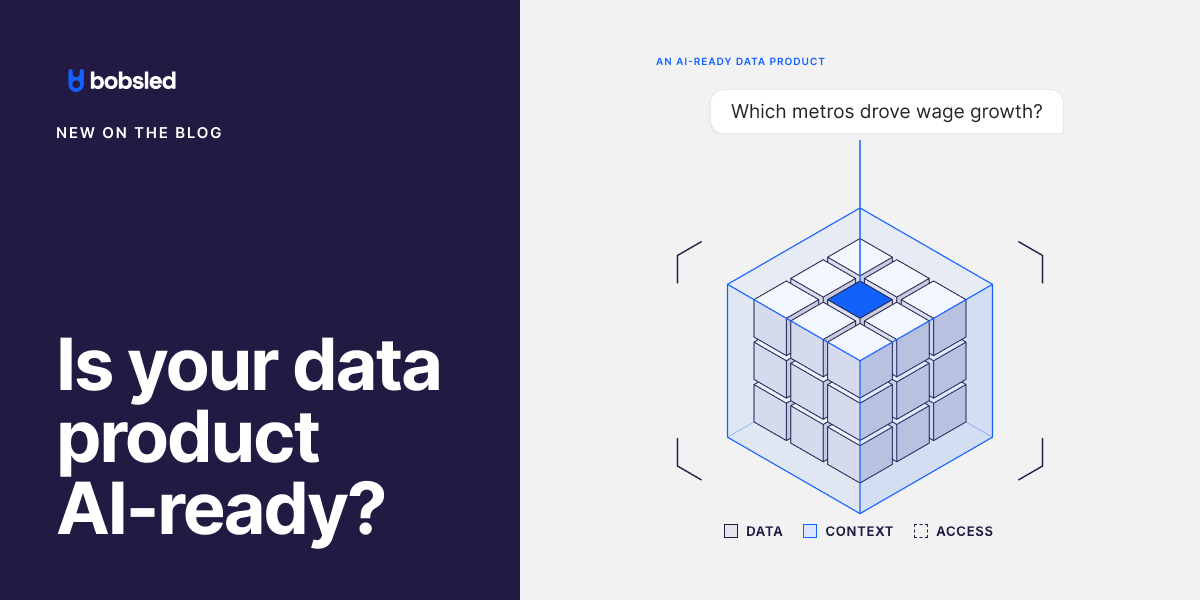
I tend to think about data products across three main dimensions: the data (what's in it, how it's modeled), context (the information about the data), and access (how someone interacts with it).
| Layer | Question | Human-ready data product | AI-ready data product |
|---|---|---|---|
| Data | Is the data detailed, current and checked enough to trust? | Abstraction and usability • Denormalized, pre-aggregated tables • Batch updating and quality assurance | Detail and completeness • Normalized, granular tables • Real-time updating and quality assurance |
| Context | Does the user know what the data means and how to use it? | Docs as reference • Data dictionaries • Starter queries • Use cases | Docs as code • Semantics (models, relationships, metrics) • Agent context |
| Access | Can the user reach the data and its context where they work? | Human analyst • UI Apps • APIs • Feeds | Analytics agent • AI Chat • MCPs • Semantic feeds |
What are the components of an AI-ready data product?
An AI-ready data product has three main layers: data, context and access. Each plays an important role in helping the agent use your data correctly and ensuring that the system learns from usage so accuracy improves over time.
Data
In most cases, the data itself stays the same. But there are three things every data product manager should consider in the agent era that change the way products are built.
- Unstructured data: AI has dramatically reduced the cost of processing unstructured data. Text, documents and images can now be used without significant engineering resources. Many data product teams have begun expanding access to semi-structured data and creating more access points for unstructured files.
- Normalized modeling: We're still learning the best practices for modeling data for agents. But we're seeing that because agents can write SQL at 100x the rate of humans, denormalization becomes less important.
- Data quality: As the saying goes, many eyes make all bugs shallow. With unlimited intelligence, those errors, which have hid in your data for years, become much more obvious. In order to meet that higher requirement, teams need to use agents to constantly evaluate data quality and fix problems before consumers find them.
Context
Context is the most important element in an AI-ready data product. What was once referenced by a human occasionally is used by an agent with every query it writes. Good context lets an agent understand and navigate your product correctly through a semantic model, and handle more complex analyses through agent context.
At Bobsled, we talk about two different types of context: semantics and agent context.
Semantics
A semantic model is the map for your data. It documents each field, tells an agent what it's for and how it was calculated, and shows how tables and fields relate to one another. A good semantic model gets agents from A to B fast.
A semantic model includes:
- Models: A model describes one table in plain terms: what a row represents, what each column means, and which values to expect.
- Relationships: Relationships state how tables join and on which keys, so the agent doesn't have to guess a join path.
- Metrics: A metric defines a calculation once, such as net revenue or active users, so every answer that uses it gets the same number.
- Resources: Resources are the supporting documents, such as methodology notes and known caveats, that the agent can read when a definition isn't enough.
Agent context
For years, data product teams have created resources to help analysts run common workflows. They build case studies, solution accelerators, and starter queries, as well as API endpoints for things like data enrichment.
Today, that logic lives in agent context. It gives agents a way to run more use case-specific workflows without building them ad hoc from the semantic model. Where a semantic model describes the data, agent context describes how to use it.
Agent context includes:
- Verified queries: SQL your team has checked against a common question, which the agent can reuse or adapt.
- Skills: Written steps for a whole task, from choosing the right data to checking and explaining the result.
- Custom instructions: Standing rules for reading the data, such as which table to start from or which filters always apply.
- Context libraries: Corrections and notes captured from real usage, reviewed by your team and available to every later session.
Access
If an agent cannot access your data and context, there's no point in building them in the first place. A new generation of access surfaces has emerged that lets agents reach the data and context together. This significantly improves reliability and accuracy.
These include:
- Chat apps: A chat interface inside your own product, where the agent already has the data and its context.
- MCPs: A connection that lets consumers bring the AI tool they already use, such as Claude or ChatGPT, to your data and its context.
- Semantic feeds: The data delivered to a consumer's own environment with its context as files, for teams building their own agents.
Where to start
Most data product teams are now well on their journey toward making their data AI-ready. At Bobsled, we typically start with an AI data readiness assessment that provides a benchmark for where to invest:
- Data quality and veracity score: How often the data is wrong, stale or incomplete, and which kinds of error are behind it, such as duplicates, gaps, mislabeled fields or values that don't match their source.
- Data model readiness: Whether the tables are detailed and well structured enough for an agent to query accurately, at a cost that holds up as query volume grows.
- Context coverage and performance: How much of the product your semantic model and agent context describe, and how accurately an agent answers real questions when it uses them.
- AI user journey mapping and coverage: Where your consumers run their analysis, whether in chat, through an MCP or on a semantic feed, and whether each of those paths delivers the context along with the data.
- Feedback and self-improvement: Whether corrections from real usage make it back into the data and context, so the next session starts from a better place.
Want to learn more? Reach out to run through a 60-minute diagnostic with the Bobsled team.